Sample report · a walkthrough
This is what you get. Here's how to read it.
A real report on Robert Pattinson's casting as James Bond, across six Southeast Asian markets, as it was delivered on 19 November 2026. 6 stops, about two minutes. Nothing here is mocked up; every number and quote is from the report.
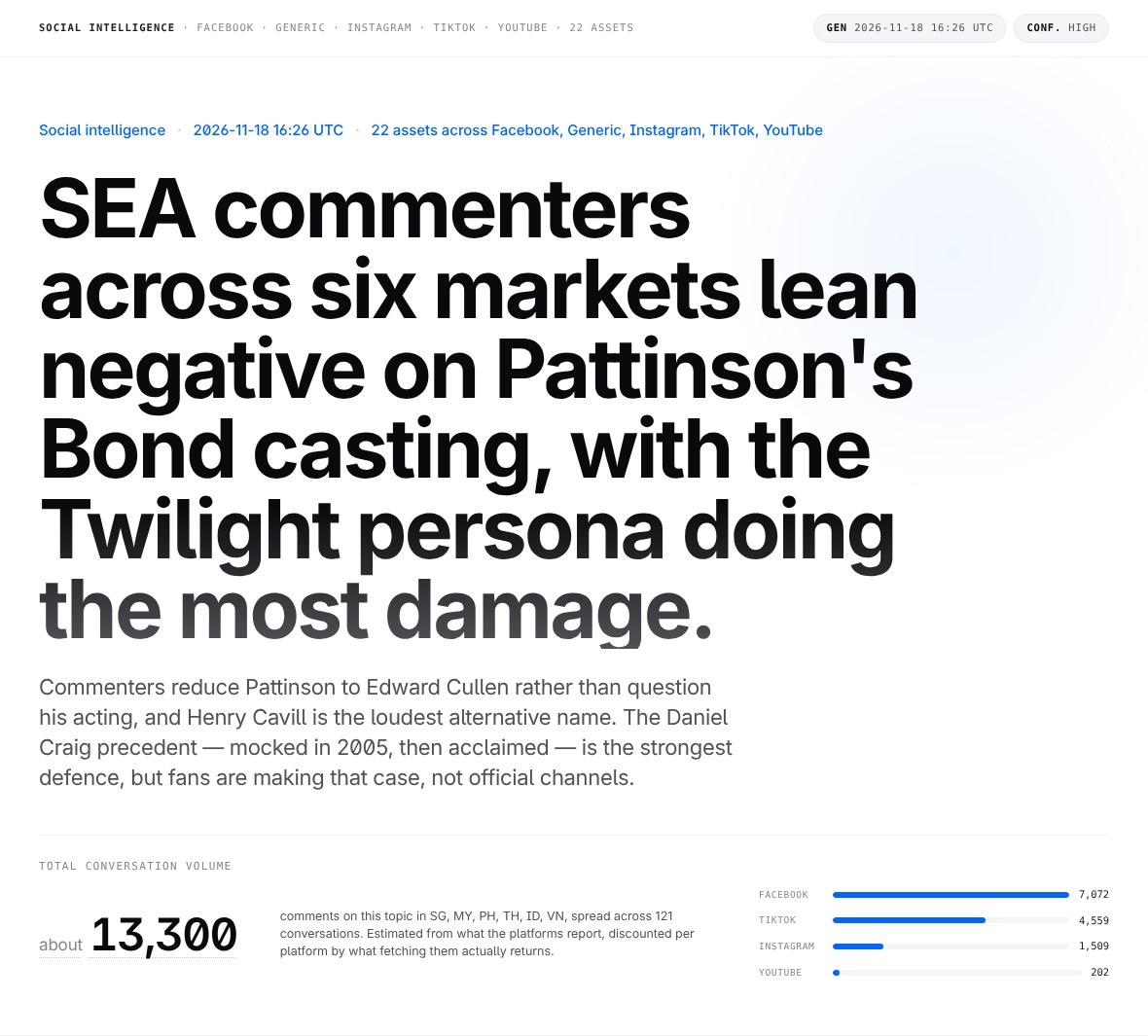
The whole conversation, in one sentence
The first thing you see is the finding, not a dashboard.
- aWhen it ran and what it read: 22 public posts and articles across Facebook, TikTok, Instagram, YouTube and the web.
- bThe headline is written from the comments, not from a brief. Here: six markets lean negative on the casting, and the Twilight image does the most damage.
- cThe paragraph under it names what people reach for: Edward Cullen as the objection, Henry Cavill as the alternative, Daniel Craig as the defence.
- dHow much conversation there is on this in the six markets: about 13,300 comments, most of them on Facebook and TikTok.
How much was read, and which way it leans
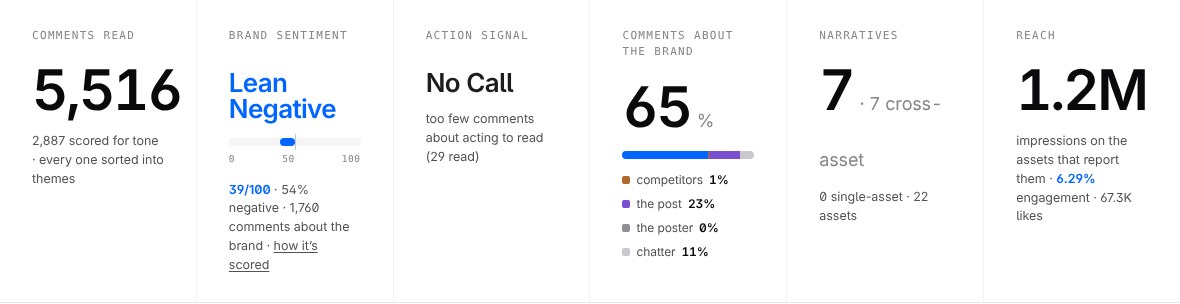
The numbers that tell you whether to trust what follows.
- aAll 5,516 comments were read and sorted into themes. 2,887 of them, a sample from every theme, were also scored for tone.
- bLean negative: 39 out of 100, where 50 is even, among the 1,760 scored comments that are about Pattinson and take a side.
- c65% of the comments are about Pattinson himself. The rest are about the post, other actors or nothing much, and they don't count toward his tone.
A paragraph you can lift into your deck
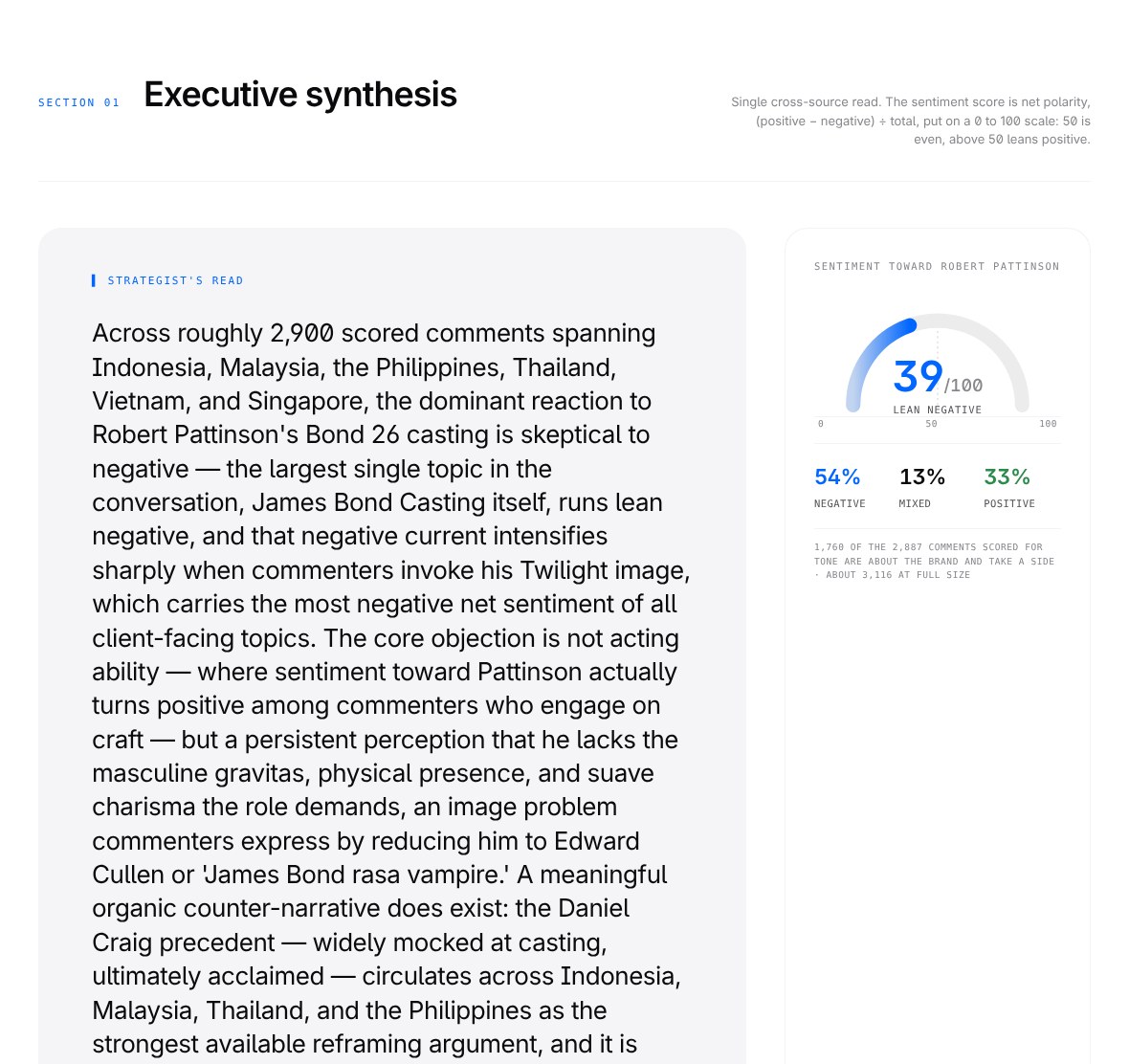
What a strategist would tell you after reading every comment.
- aThe strategist's read: the objection is presence, not talent. Commenters who talk about his acting lean positive; the ones who say no reduce him to Edward Cullen.
- bThe tone in one gauge: 39 out of 100. 54% negative, 13% mixed, 33% positive.
How tone is worked out
- Read the post first. Each post is summarised before its comments are touched: what it's about, who it's for, its own tone. “That was insane” means one thing under a crash video and another under a product review.
- Judge each comment in words. Each comment gets a short written judgment of where it stands, in context and in its own language, including sarcasm and in-jokes. No score yet.
- Match it to a fixed scale. That judgment is matched to the closest of five fixed descriptions, from strongly negative (1) to strongly positive (5). The same five descriptions are used on every report, so the model never makes up a number.
- Net it out. Tone is the share of positive comments (4–5) minus the share of negative ones (1–2), put on a scale from 0 to 100 where 50 is even. Here: 33% positive and 54% negative comes to 39.
Only tone uses a sample. The themes and their sizes come from all 5,516 comments. Tone is scored on a sample from every theme: all of a theme's comments when it has 30 or fewer, and up to 95 from the biggest, so small themes get scored as well as big ones. 2,887 were scored here. The posts themselves are scored the same way, so the report can tell a post's own tone apart from its audience's.
What people are actually talking about
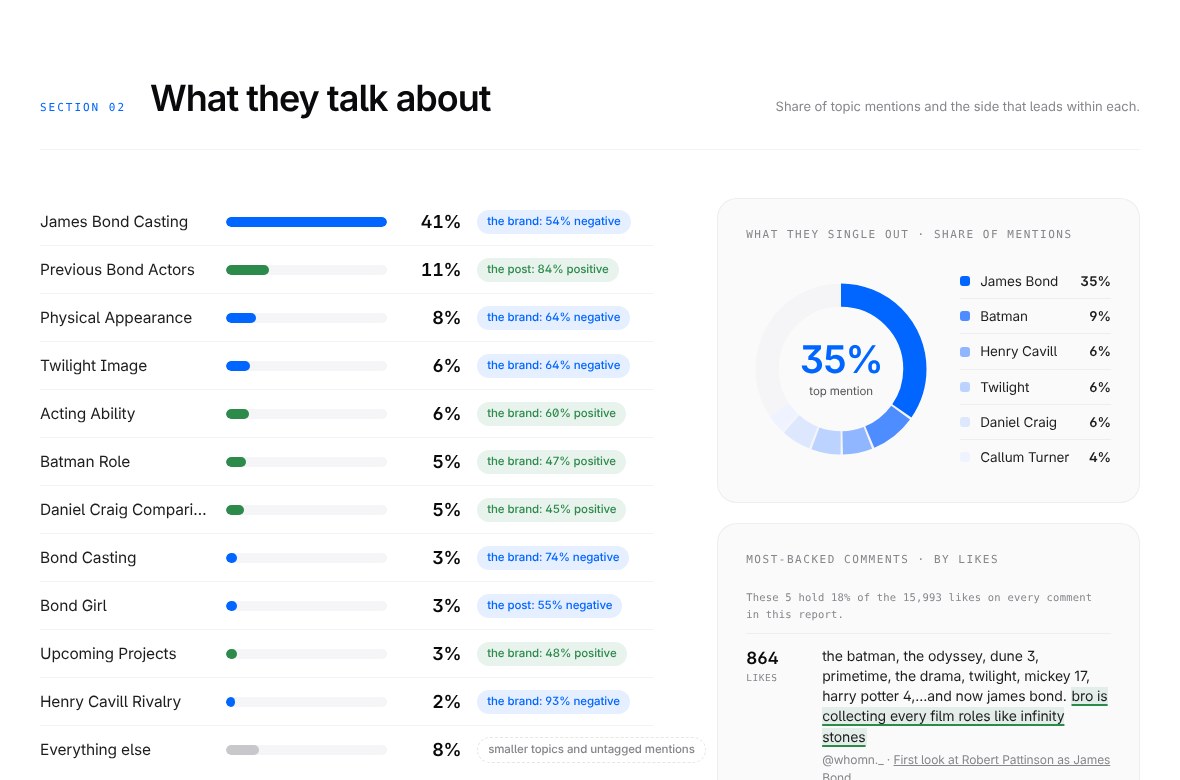
Each topic's share of the conversation, and the side it leans.
- aThe casting itself is the biggest topic: 41% of mentions, and 54% negative.
- bActing ability is small, 6%, but it is the topic that leans his way: 60% positive.
- cThe Henry Cavill comparison is smaller still, 2%, and the most one-sided: 93% negative.
- dWhat people single out by name: James Bond first, then Batman, Henry Cavill, Twilight and Daniel Craig.
Every theme, with the comments behind it
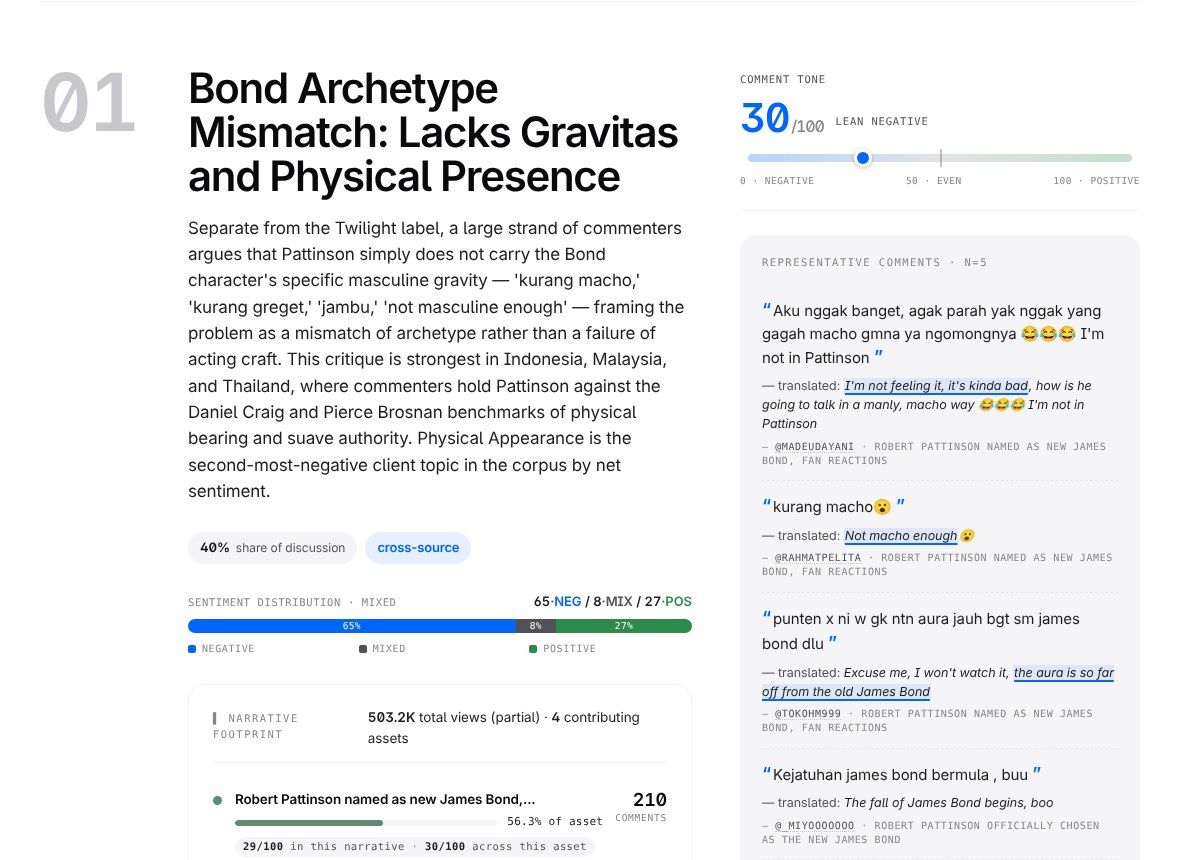
Seven themes, ranked by how many comments carry them. This is the biggest.
- aThe theme, named from what the comments say: he doesn't fit the Bond archetype.
- bIts tone: 30 out of 100, lean negative.
- cIts size: 40% of the themed comments, and it shows up across posts, not on one viral video.
- dThe comments behind it, in their own language with English beside them, linked to where they were posted.
The same story, market by market
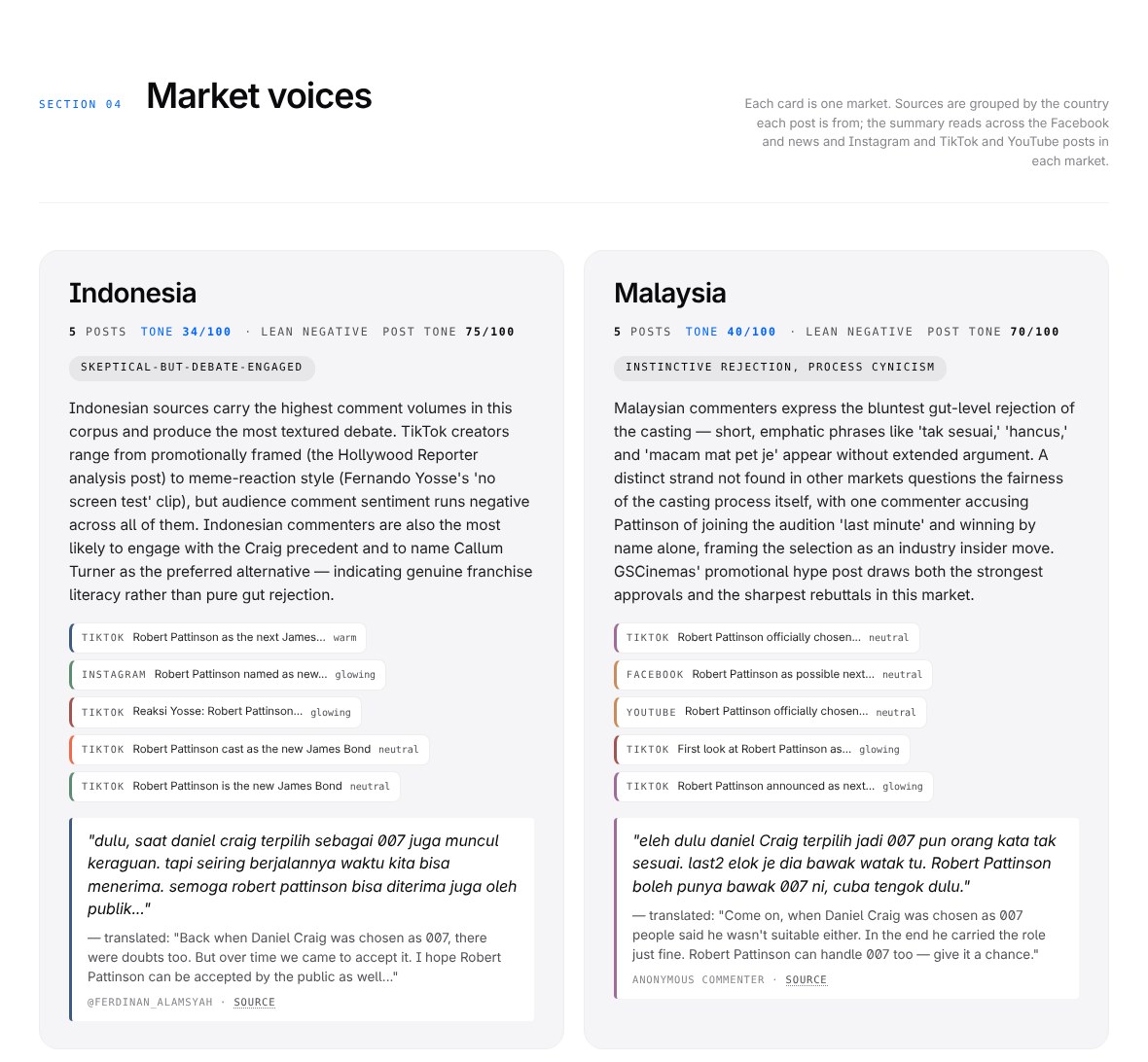
One card per country, so a regional read doesn't flatten six audiences into one.
- aEach market gets its own tone. Indonesia sits at 34 out of 100.
- bAnd its own character, in a phrase. Malaysia's: instinctive rejection, and doubts about how he was chosen.
- cA comment that sums the market up, in the original with a translation.
Now read the whole thing.
Seven themes, six market voices, every source and the methodology, exactly as delivered.